Weekend Reading is a short Friday column on the stories behind the cards people collect and what they bring at auction. This week is about why people buy them, starting with a boy in Pennsylvania who traded one hobby for another.
Three PSA 1s: Ruth, Mantle and Robinson
On November 12, Sports Collectors Daily told the story of a father and son from Mountain Top, Pennsylvania. The son, who turns 11 this month, had built up thousands of Pokémon cards. They sold some of the better ones and bought three cards from baseball’s golden age: a 1933 Goudey Babe Ruth, a 1951 Bowman Mickey Mantle and a 1952 Topps Jackie Robinson. All three are graded PSA 1. The Mantle is his favorite.
PSA 1 is the bottom of the scale, the grade PSA calls Poor, and I love that they went there anyway. A number on a PSA label still means the card is real and hasn’t been altered, and a Ruth with soft corners is still a Ruth. Most of us who started young would have taken that trade in a heartbeat.
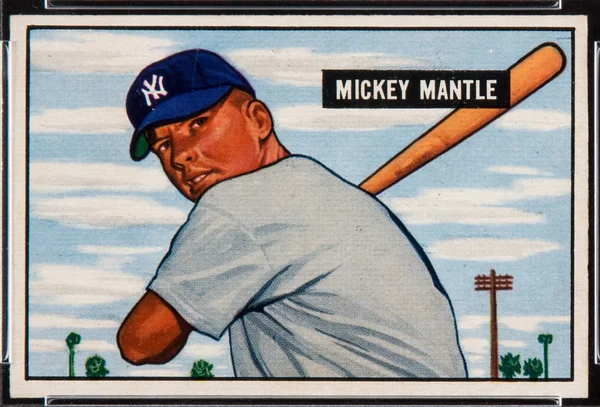
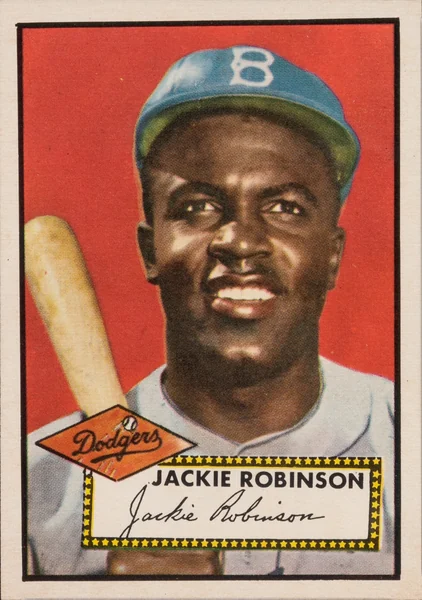
Two of the three cards they bought, in better grades than theirs. Images: Heritage Auctions / HA.com
Two small things worth knowing about what they bought. The 1952 Topps Robinson is No. 312, the card right after Mantle’s No. 311, which puts it in the same short-printed high series. And the 1933 Goudey set has four different Babe Ruths, Nos. 53, 144, 149 and 181; the story doesn’t say which one they found. No. 144 is the one we follow.
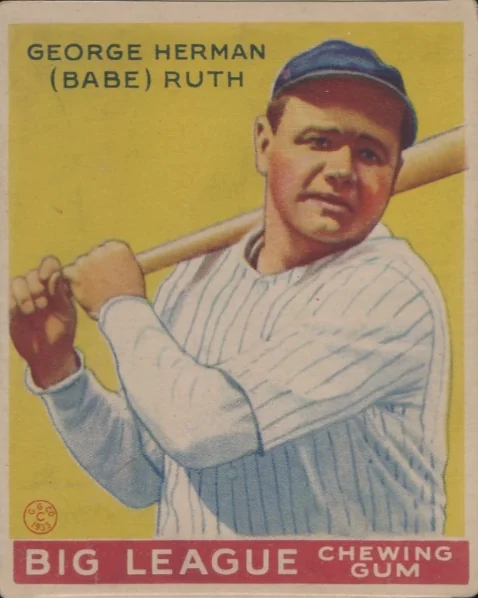
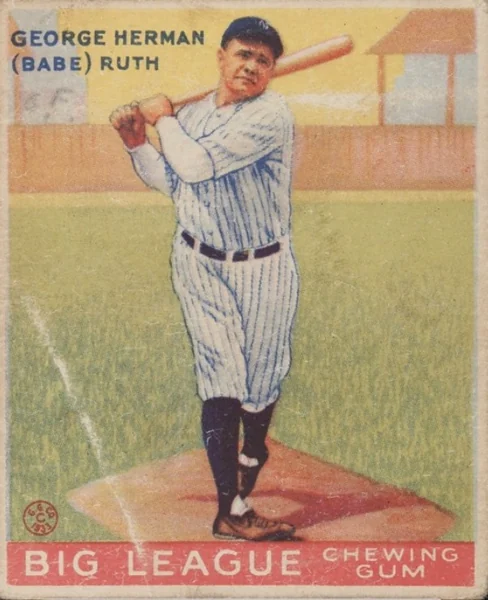
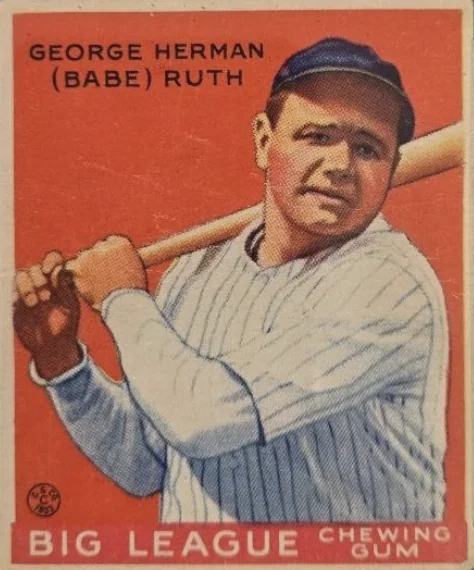
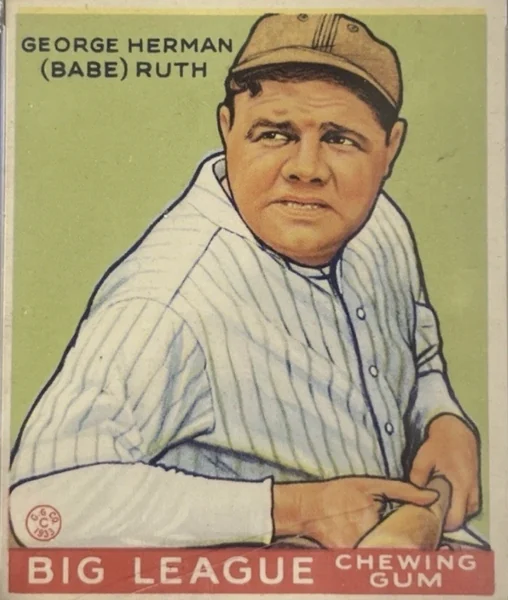
The four Babe Ruths in the 1933 Goudey set. The story doesn’t say which one they found.
The next card on his list is the 1948 Leaf Jackie Robinson, No. 79, his rookie card and one of the thirty-nine cards we follow. His dad told the reporter his son already sees his cards as investments. As a financial planner by profession, I love it when a kid sees the value in the long game. Good taste at 11.
Babe Ruth’s $10,000 for Ten Games in Cuba
On September 7, 1920, Babe Ruth signed a one-page contract, as “Geo. H. Ruth,” that guaranteed him $10,000 to play exhibition baseball in Cuba. He got $2,000 on signing and $8,000 by October 20, plus travel and a hotel for himself, his wife Helen and his secretary, for no more than ten games between October 31 and November 14. That is about $1,000 a game.
The promoter, the Cuban businessman Abel Linares, had arranged for Ruth to join John McGraw’s New York Giants against Cuban clubs in Havana, mostly at Almendares Park. Ruth hit .345 with two home runs in the games the contract covered. The day people remember is November 4, when Almendares beat the Giants 11–4 and Cristóbal Torriente, later elected to the Hall of Fame, hit three home runs and a double. Ruth took a turn on the mound that day and gave up the double.
The contract has been to auction twice before, and Sports Collectors Daily has both: $6,900 at Christie’s in October 1994, and $118,750 at Goldin in 2017. On Monday, November 16, it went up again as lot 47101 in Heritage’s Historical Documents auction. It sold for $50,000, including the buyer’s premium.
That paper trail is the best thing about it. When a piece has sold in public before, anyone can follow it from one owner to the next, and you know exactly what you’re looking at. For a hundred-year-old document, that’s worth almost as much as the signature.
Ruth’s paperwork from those years still turns up. In October, Heritage sold a 1930 New York Yankees payroll check, drawn on the club’s road account: No. R64, dated March 12, 1930, for $210, signed by the Yankees’ road secretary, Mark Roth. A typed line on the back says what it was for: “Hotel Bill allowed Ruth as per Voucher.” It was spring training, and the back also carries a bank stamp from St. Petersburg, Florida, where the Yankees trained. Ruth endorsed it the same way he signed the Cuba contract: “George H. Ruth.” It sold on October 24 for $9,150.
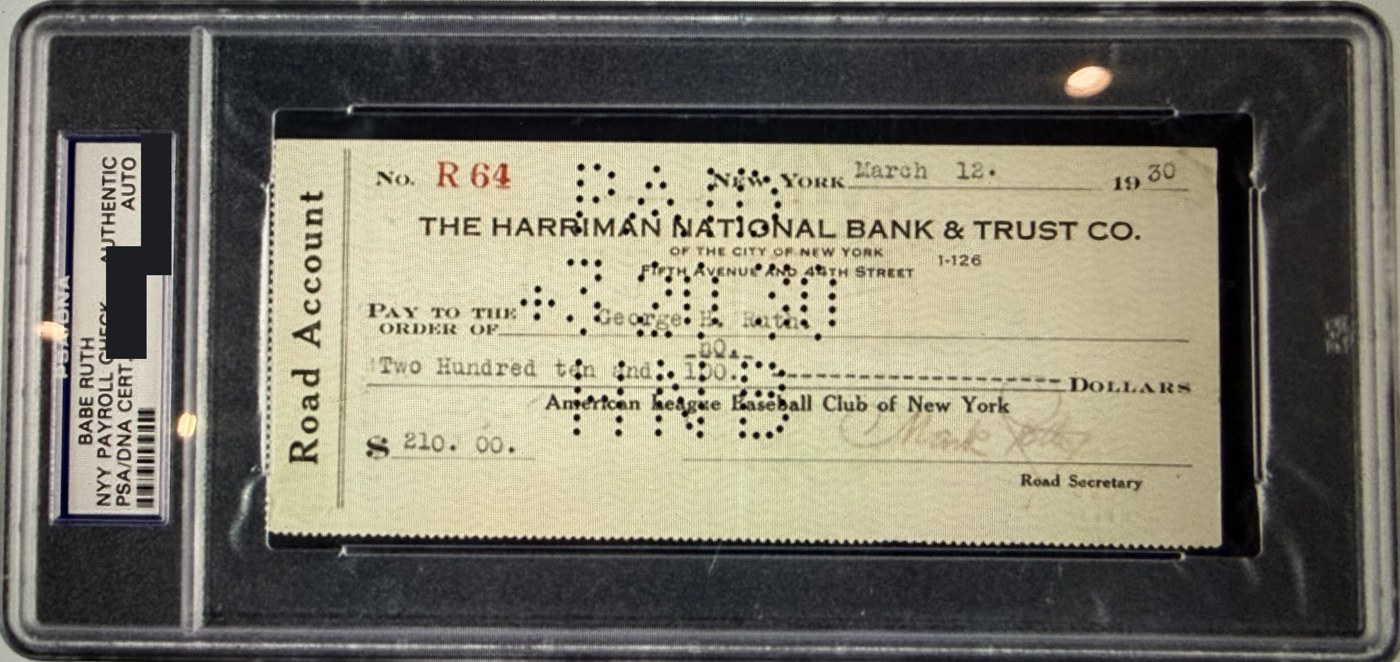
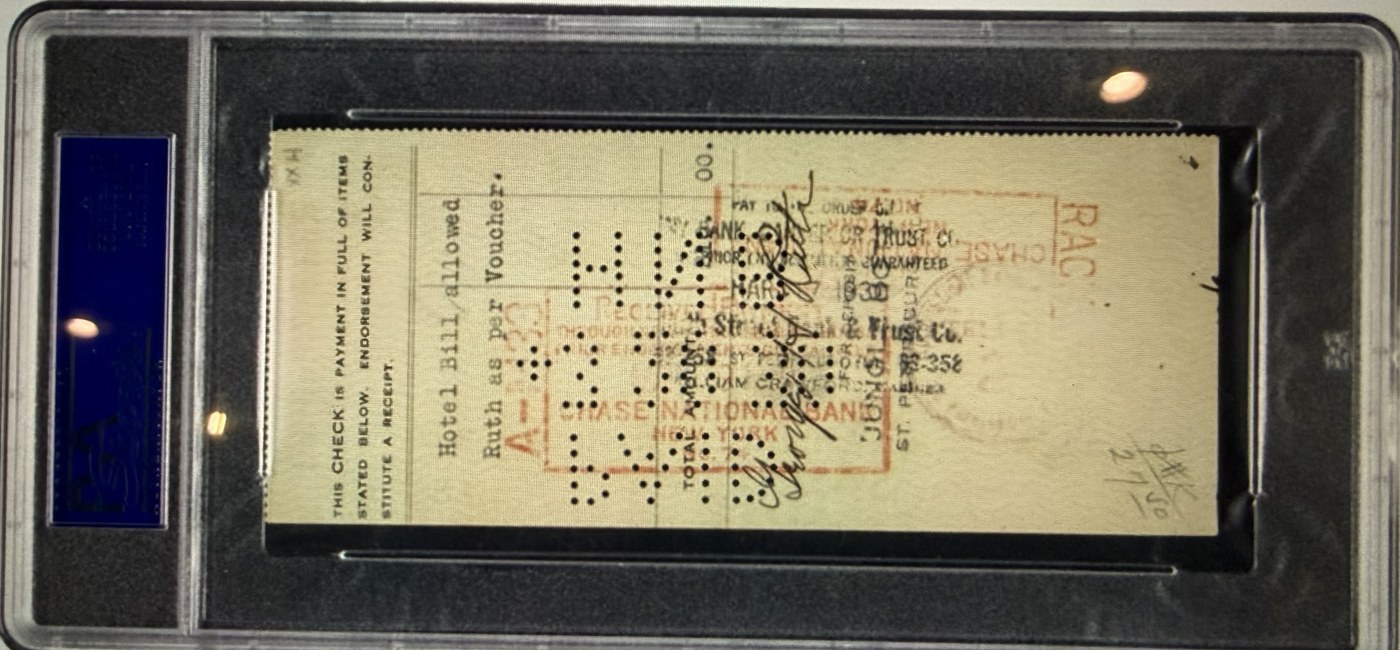
The 1930 Yankees payroll check, front and back. Certification number blotted out. Image: Heritage Auctions / HA.com
Abraham Lincoln, From a $6.99 Pack
A collector in Colorado Springs bought a $6.99 fat pack of 2026 Topps Allen & Ginter at his local Target and pulled a one-of-one: a card set around a signature of Abraham Lincoln. Sports Illustrated reported on November 11 that it’s headed to Heritage’s December auction.
If you’ve wondered how a president who died in 1865 ends up in a 2026 pack, this is how. It’s a cut autograph: card makers buy old signed letters and documents, cut the signatures out and set them into cards. The name on the pack is older than the card, too. Allen & Ginter was a Richmond, Virginia, tobacco company that put cards in its cigarette packs in the 1880s, and Topps brought the name back in 2006.
It’s a good reminder that the big pulls don’t all come out of expensive boxes. This one came off a shelf at Target for less than the price of lunch.
On the Block
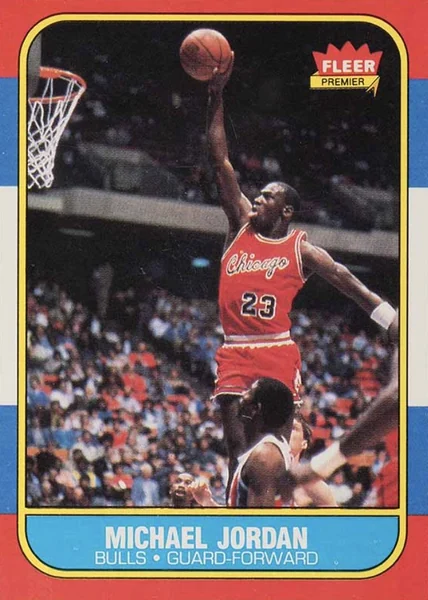
Heritage Sports Showcase, closes Saturday, November 21, from 10pm CT (11pm ET). Four 1986 Fleer Michael Jordan rookies, No. 57, in four grades: PSA 6, SGC 6.5, PSA 8 and PSA 9. If you want to see what a grade does to one card, watch all four close on the same night. Each lot keeps running in 30-minute steps for as long as new bids come in.
From around the hobby
The 1980 Charlotte O’s Police Set (Sports Collectors Daily). Twenty-five orange-bordered cards, a young Cal Ripken Jr. among them, handed out one at a time by police officers to kids in Charlotte.
TTM This Week: Vintage Football Bonanza (Sports Collectors Daily). A week of autographs that came back through the mail, each with a short note on the player who signed it.
Three very different reasons to own something this week. A boy wanted names that have meant baseball for a hundred years. A hundred-year-old contract keeps changing hands because of the man who signed it. And somebody opened a pack in a store aisle and found a president. None of it depended on the grade. The Ruth in that boy’s collection is a PSA 1, and it’s still Babe Ruth.
— Greg